“What is the connection between Austria and Australia?”
It sounds like a comical question you’d hear from a child. And one you’d most likely answer in the negative or in a light-hearted perhaps patronising way. After all, one is a country of Mozart, Apfelstrudel and skiing. The other of bogans, barbeques and surfing. One is completely landlocked with eight different countries at its borders. The other is completely free of any country at its border with only two oceans (and sharks) for company. Austria is Australia’s ninth (9th) largest European trading partner for total goods and services trade. And no, I’m not even counting the UK in that statistic as we are no longer “European”. On the surface, the red and white colours on their flags would be the only similarity between the two countries that are more than 13,000km apart.

The Last Gundir novel presented a surprising fact regarding the European connection with Australia (refer to my earlier blog titled “Who were the first European explorers in Australia?” on this website). In writing novel 3, I decided to include another surprise connection between Europe (specifically Austria) and Australia. And this is one that I’d hazard would take any Austrian or German by surprise.
To understand it, one would have to go back to Europe in the early Iron Age. At that time, the Germanic peoples were settled in present day Austria and Switzerland with the Celtic peoples settled in present day Germany.

The land of Austria was thus known as the Eastern Realm as it lay to the east of the main Germanic speaking people. In their language, it was called Österreich (the Eastern Realm) with Öst meaning east. And today, Austria is still called Österreich in German.
Some time later, the Germanic peoples migrated north, pushed the Celts to the west and settled in present day Germany.
Later on when Latin was being developed as a language, it took inspiration for the directional terms from the nearby spoken Germanic language. In particular, it perceived that the name Österreich contained a directional term for that land relative to the Germanic people. The problem was that the people of this land were now situated to the south of the main Germanic speaking peoples.

And Latin made the mistake.
It took “Öst” to mean south in Germanic and thus used “Aust” for south in its own language. Both words are pronounced identically.
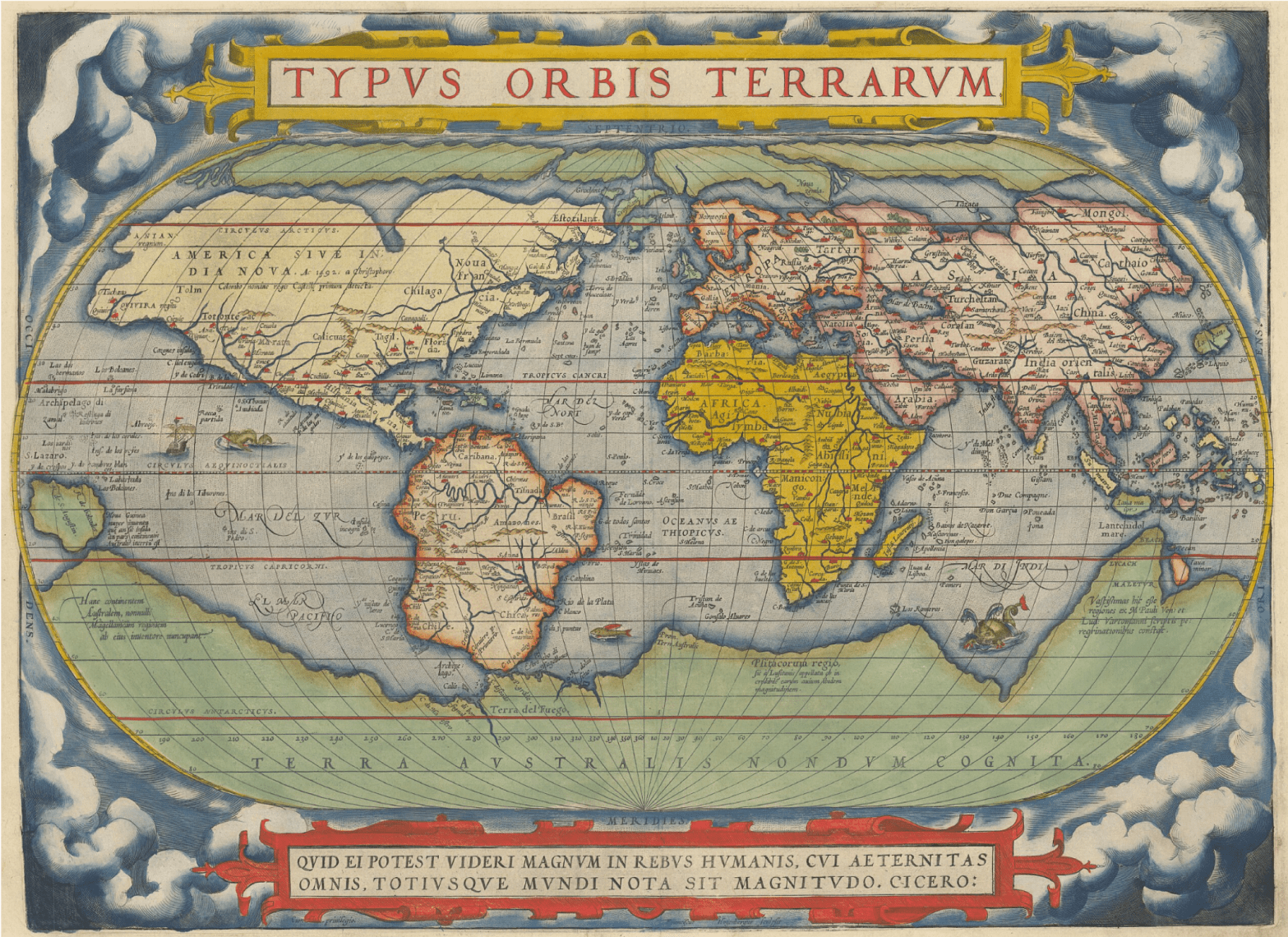
Now fast forward to the 5th Century and readers of The Last Gundir would know that the philosopher called Ptolemy proposed an absurd theory that there must be an enormous land mass in the south to balance the known land in the north. He proposed the term “Terra Australis Incognito” for this land (meaning the Unknown Southern Land). Various maps throughout the decades from this time depict a huge land mass in the south and apply this term to it. The below is one example.

Moving onto 1606 and the Dutch become the 2nd European country to arrive in Australia. They chart its western coastline and call it New Holland. They also come across the southern coast of Tasmania and the eastern coast of New Zealand. My first novel The Last Gundir uses this map for its front cover. You can even see the words Nova Hollandia on it.
Moving onto 1770 and the Brits become the 4th European country to come across Australia. Lieutenant James Cook takes possession retrospectively of the eastern coastline, calling it New Wales (later New South Wales) but acknowledges that the western coastline belongs to the Dutch. Readers of The Last Gundir know why he had to do this (Chapter 27). Thus, for a good 40 years or so, Australia had a name for its eastern coastline (New South Wales) and a name for its western coastline (New Holland).
In 1803, Lieutenant Matthew Flinders became the first European to complete a full circumnavigation around Australia (refer my blog titled “Bungaree” to learn about the first Aussie to do this). A year later, he proposed a solution to the quandary of two names for the same continent by suggesting that it be simply called “Australia” (after the term Terra Australis Incognito as this land was a huge land mass in the south). The Admiralty agreed in 1824.
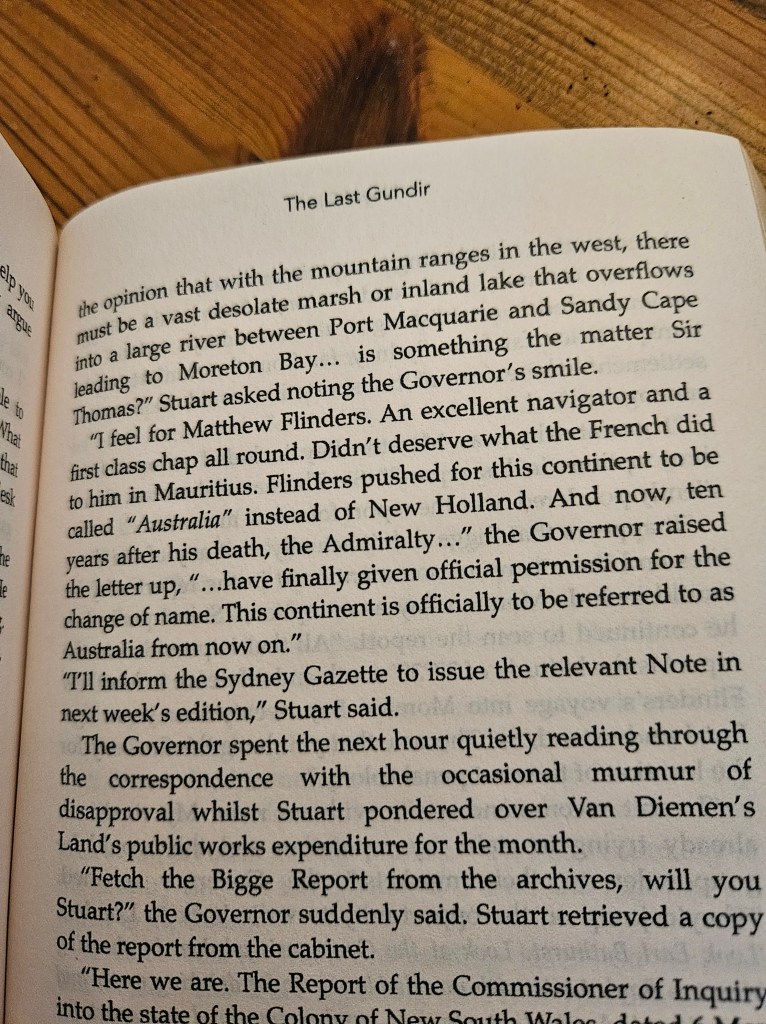
And thus, we got the name Australia.
Which comes from Australis.
Which has the Latin term “Aust” meaning south.
Which was the wrong translation from the Germanic word “Öst”.
Which was taken from the country name Österreich.
Which was (and still is) the German name for Austria.
Which is now to the south of the main German speaking people. But was once to the east of them.
So, there you have it. The next time, someone asks you for the connection between Austria and Australia, tell them to put the kettle on.
Novel 3 continues the story from where Wrong Side ended and covers the period 1826 – 1830 in the Brisbane region. Whilst exploring the First Nation lifestyle of this period, it will include a lot more fascinating facts behind the places, people and culture of the land we call Australia now.
 Nayef Din