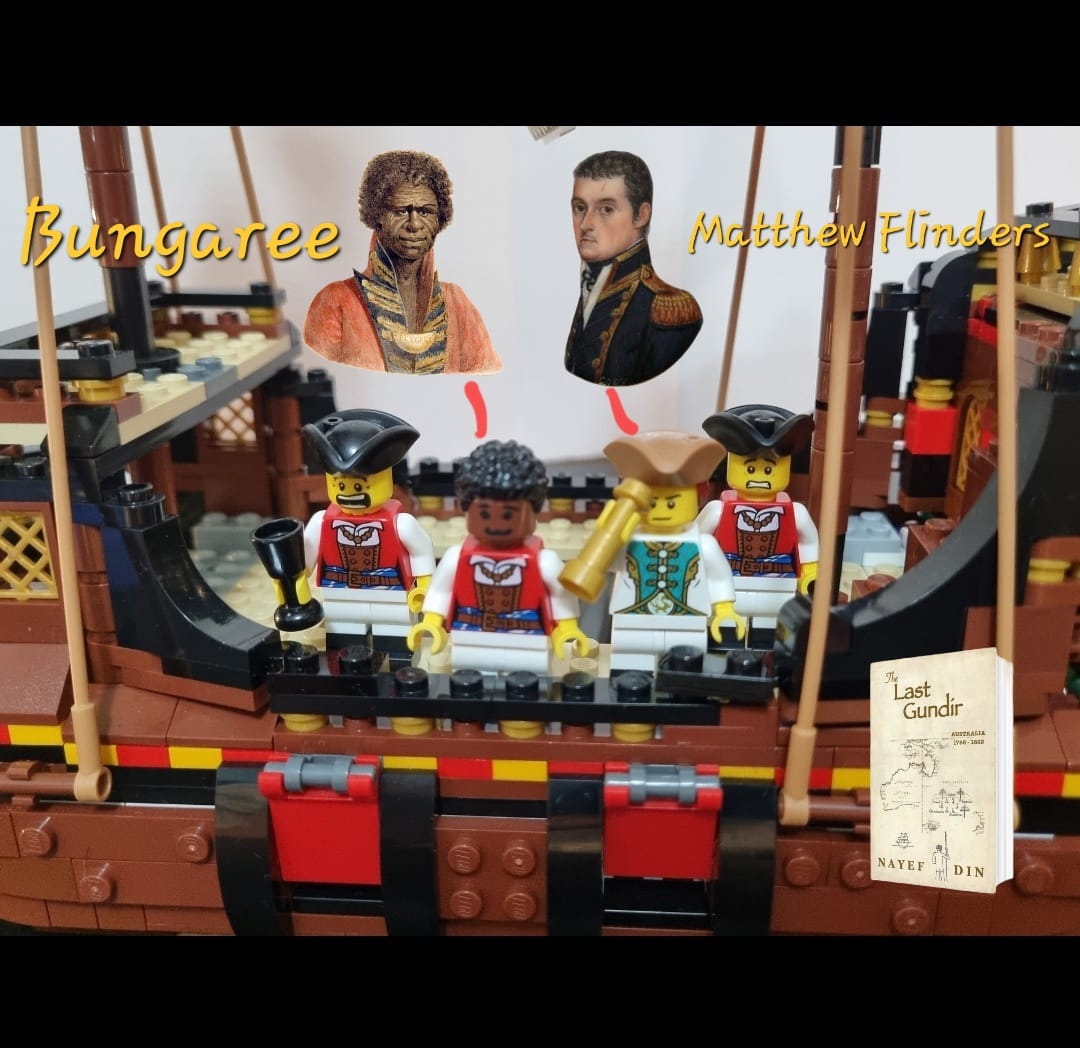
Who was the first Australian to circumnavigate the continent of Australia?
Last year, during NAIDOC 2022 week, I wrote blogs on 2 of the 3 Aboriginal leaders mentioned in my novel The Last Gundir. I talked about the resistance fighter Pemulwuy, highlighting the respect and fear that people in the region had for him. “The Man Who Could Not Be Killed” was the term applied to him at the time. I also talked about Bennelong, presenting his ability to walk in two worlds and his capacity for delayed vengeance as well as forgiveness. As NAIDOC week closes this year, I shall write about my favourite of the three – Bungaree. A truly unsung hero of Australian history.

Bungaree was a Kuringgai (present day Broken Bay, NSW region) boy of 13 when he saw the ships of the First Fleet sail by on their way to Sydney Cove. When the colonial invasion reached the Hawkesbury River and his country was taken over, the Kuringgai people had nowhere else to go. Many perished with smallpox and starvation but others learnt to adapt and live with the British. And so, Bungaree – now a tall, intelligent man with a happy disposition- arrived in Sydney and quickly learnt to speak English. His ability to move seamlessly between cultures was second to none and his humorous impressions of key characters of the colony made him a popular man. It wasn’t long before the settlers treated him as the leader of his people despite the fact that he was not a traditional elder. Bungaree was often seen wearing an army coat, trousers and black hat around the colony.

Then, in May 1798 when Bungaree was 23 years old, a young British captain came to Broken Bay looking for a crew. The captain was tasked with exploring the continent -not yet called Australia- and wanted a guide able to converse with other Aboriginal countries. The captain’s name was Matthew Flinders.
“Bungaree’s good nature and open and manly conduct had attracted my admiration,” – Matthew Flinders.
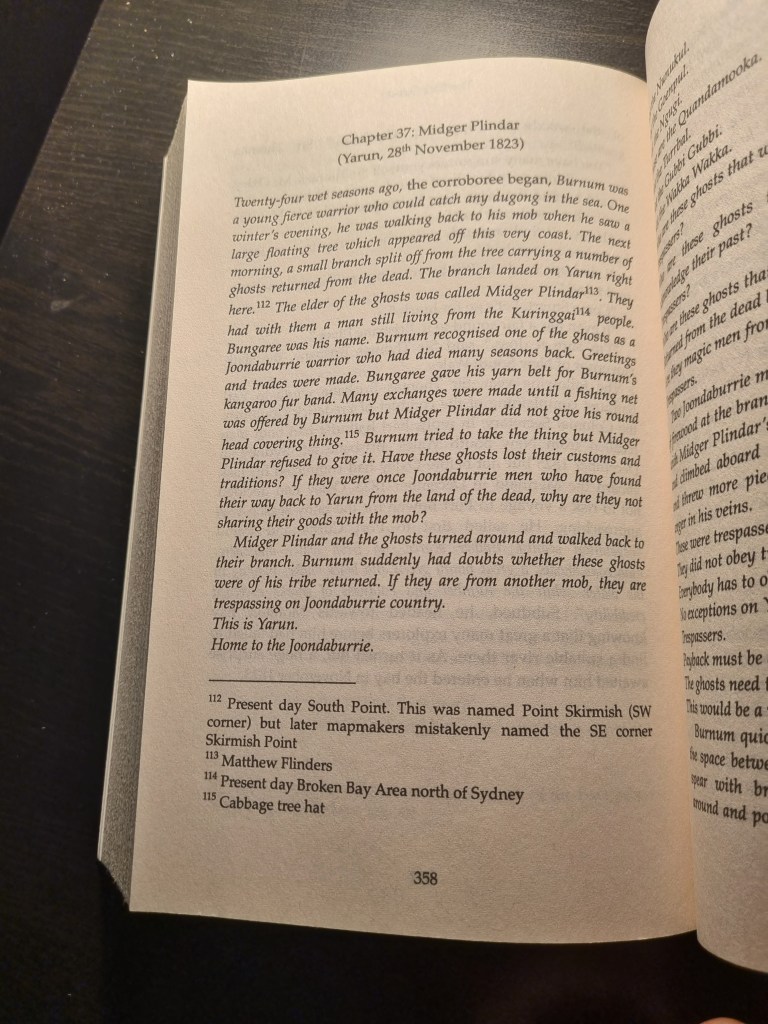
In 1799, Flinders invited Bungaree to join him on an expedition to Moreton Bay aboard the Norfolk. The confrontation that took place between the crew and the Joondaburrie on Yarun (present day Bribie Island) is described in chapter 37 of The Last Gundir and is worth finding out about. The suburb of Bongaree in the south-west corner of the island is named after the Kuringgai man.

In 1801, Flinders set off on the Investigator to sail right around Australia and complete the gaps in information from all previous cartographic expeditions. Flinders proved that Tasmania was an island and not connected to the mainland. Bungaree acted as the go-between with different local Indigenous people. This was particularly courageous as Bungaree was on lands whose language he could not speak. On several occasions, he was able to pacify aggressive tribes simply by taking off his military attire and revealing him to be “one of the living”. His impressive courage and successful diplomatic means was most admired by Flinders.
“Bungaree was a brave and worthy fellow who on multiple occasions saved the expedition,” – Matthew Flinders.

The expedition took 2 years. Flinders became the 1st captain and Bungaree the first Australian to circumnavigate the continent of Australia. When Bungaree returned to Sydney, he found that conditions for his tribe had deteriorated. The Kuringgai were reduced to begging for food because the British had taken away their land. Bungaree found a novel way to help them. Whenever a ship sailed into Sydney Harbour, he would row out to meet it and cheerfully greet the captain. He would then ask for “gifts” from the Captain’s food store. And it worked. Thus, he brought back flour, sugar and occasionally rum for his people.
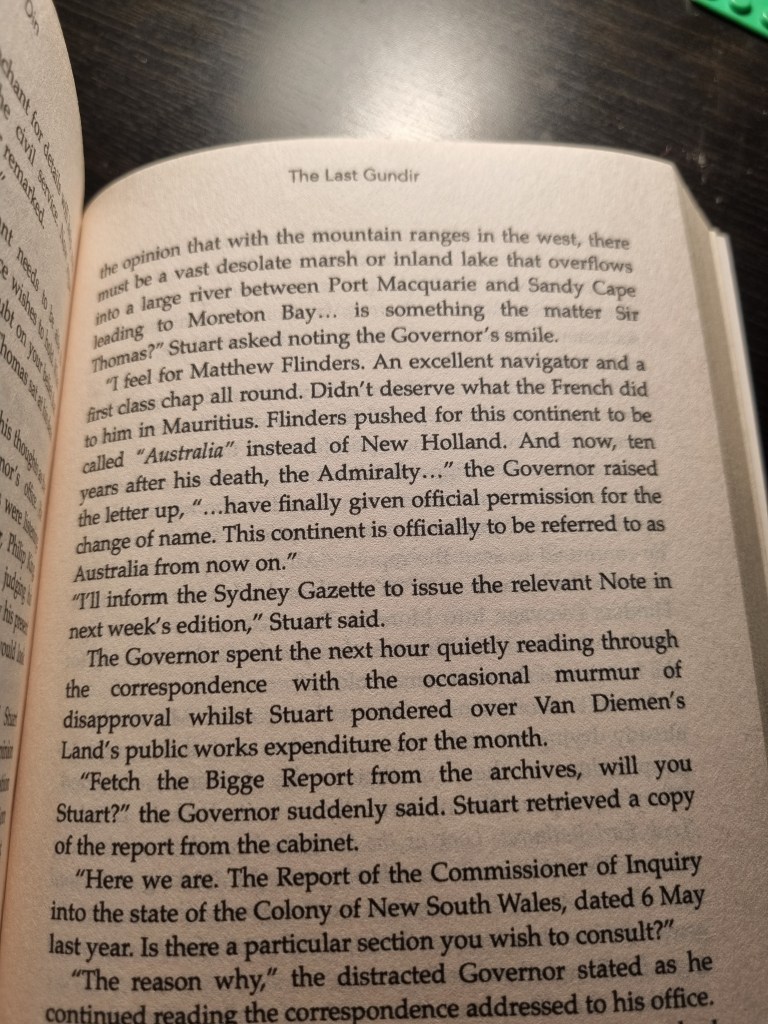
Flinders left Australia in 1803 and his story took a somewhat sad turn afterwards. I will cover that incident in a separate blog dedicated to Matthew Flinders but of note was his proposal to call the entire continent “Australia”.
In 1809, Bungaree befriended the new governor, Lachlan Macquarie. He spent many nights at the Governor’s house with laughter an oft heard sound. Bungaree’s jokes, games and imitations of various Governors’ mannerisms kept many guests entertained.
Bungaree’s people however needed a lot of help now with poverty and starvation hurting too many. In 1815, Macquarie granted them six hectares of land at George Head with cows, sheep, tools and huts to start a farm. It was not a return to the luxuriant life Kuringgai once led but it was better than how other tribes had fared following invasion of their countries. However, as expected, the farm was not a successful venture as the Kuringgai did not grow the same crops as the settlers.
In 1817, Bungaree went exploring once more aboard the Mermaid. Readers of The Last Gundir may recognise the name of the ship in the climactic ending of the novel (which did not involve Bungaree so will not be covered here).
“Bungaree was about 45 years of age, of a sharp, intelligent humble nature and promised to be of much service to us in our dealings with the natives,” – Phillip Parker King (explorer).
In his later life, Bungaree continued to greet ships in the harbour but no longer worked. His people continued to live in poverty at George Head farm. In 1821, the outgoing Governor Macquarie requested the new Governor to help Bungaree’s people. Alas, the new Governor’s response was to simply provide them with a boat and fishing nets.
By 1828, Bungaree was old and weak. He and his people moved their camp to Domain to be closer to the new Governor. The Sydney Gazette stated that “Bungaree is a part of Sydney and something ought to be done to make his remaining days easier.” In 1830, Bungaree was put into hospital. On 24 November 1830, he died, surrounded by those who loved him dearly.
Next time you visit the suburb bearing his name on Yarun (Bribie Island), do pause and reflect on the courage and bravery of this remarkable man.
Bungaree – the true unsung hero of Australian History.

 Nayef Din